The Rice and University of Houston AAUP chapters urge their campus administrations to refer to the Jerusalem Declaration https://jerusalemdeclaration.org/ for any determination of possible or actual disciplinary proceedings in cases of alleged antisemitism.
An August 2024 survey of roughly 1,000 faculty reveals deep dissatisfaction with the state of higher education in Texas highlighting the negative impact of political interference and changes to tenure protections on faculty morale and retention.
The survey showed about two-thirds (61.0%) would not recommend TX for a faculty position to their colleagues. More than a quarter (26.3%) plan to interview elsewhere this year, and more than a quarter (28.3%) have interviewed elsewhere since 2022.
Among faculty seeking to leave Texas, their greatest concern was the state’s political climate, particularly with respect to academic freedom, DEI, and tenure in higher education as well as reproductive/abortion access and LGBTQ+ rights statewide.
Faculty from across the Lone Star state and Louisiana gathered in Beaumont to learn more about academic freedom, shared governance and the upcoming Texas legislative session.
Keynote speaker David Rabban spoke about his new book, Academic Freedom: From Professional Norm to First Amendment Right. Panelists included Dr. Sandra Jordan, Chief of Staff at SACSCOC as well as AAUP members. Conference participants were able to pick the brains of North Texas lawyer Frank Hill. Mr. Hill, who represents many faculty in cases across the state talked about the basics of what to expect when one contacts a lawyer about issues on campus. FIRE staff lawyer Josh Bleisch was also a featured speaker on academic freedom in the courts.
Finally, AAUP & AFT member David Albert and TFA, TACT & TCCTA lobbyist Beaman Floyd spoke about the upcoming legislative session. The two new Interim Higher ed charges released Tuesday sets the stage for defunding the humanities and social sciences.
Thanks to Pat Heintzelman for organizing the very successful Higher Education Summit in Beaumont, Texas!
TFA President Pat Heintzelman Texas Higher Education Summit Chair
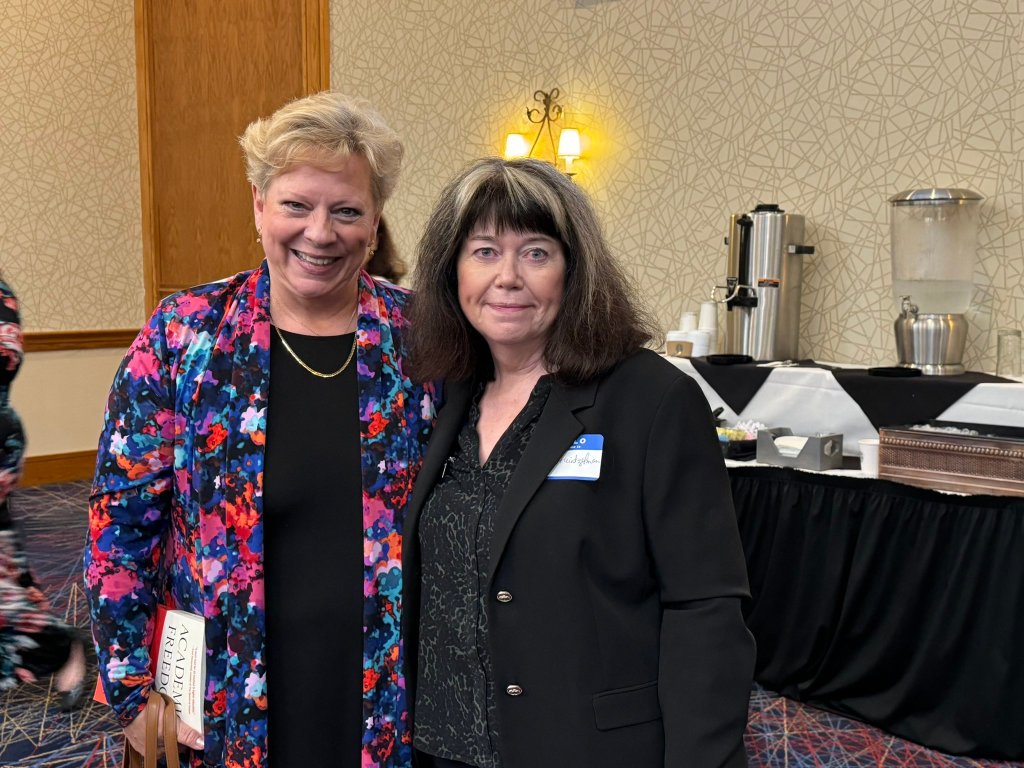
Dr. Patrick Smith, Pat Heintzelman, Beaman Floyd, and Dr. Cary Wintz
Dr. Sandra Jordan, Chief of Staff of SACSCOC, and Pat Heintzelman
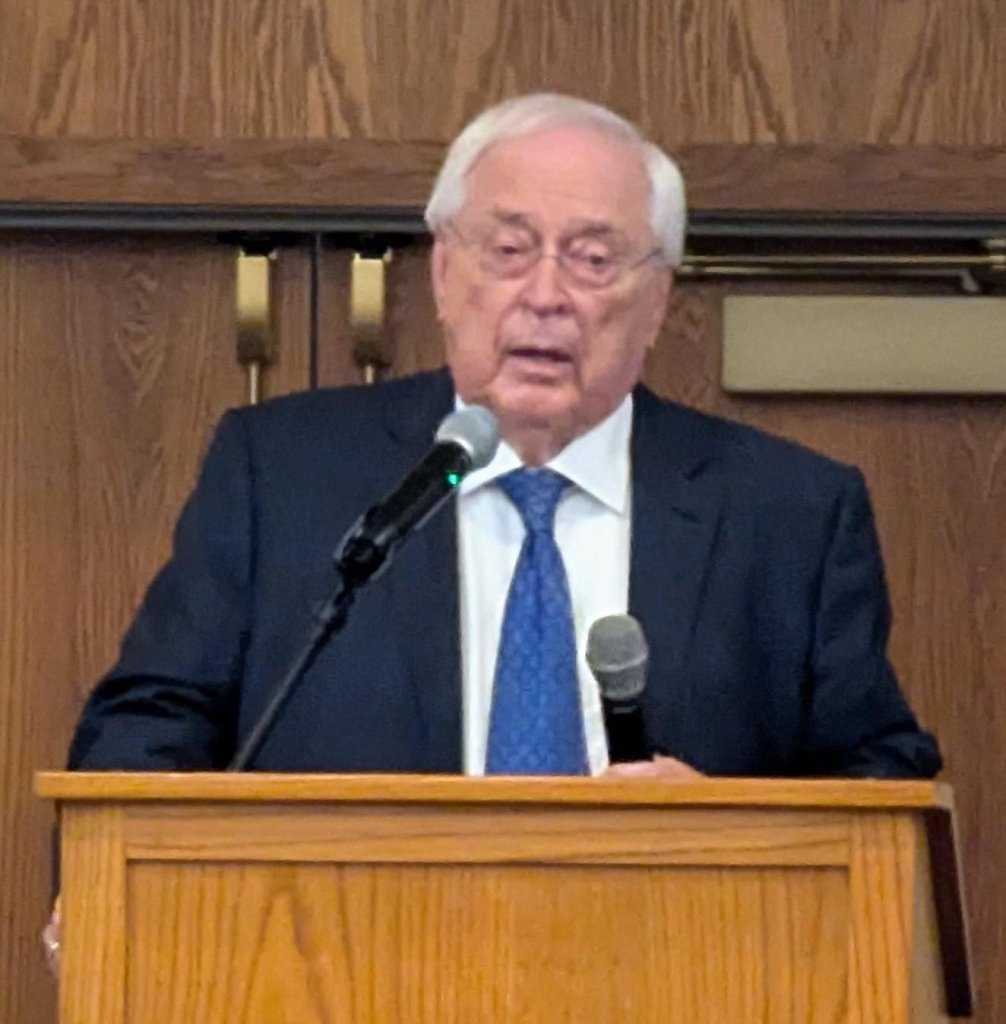
Attorney Frank Hill presenting about faculty rights and the basics of what to expect when one contacts a lawyer about issues on campus.
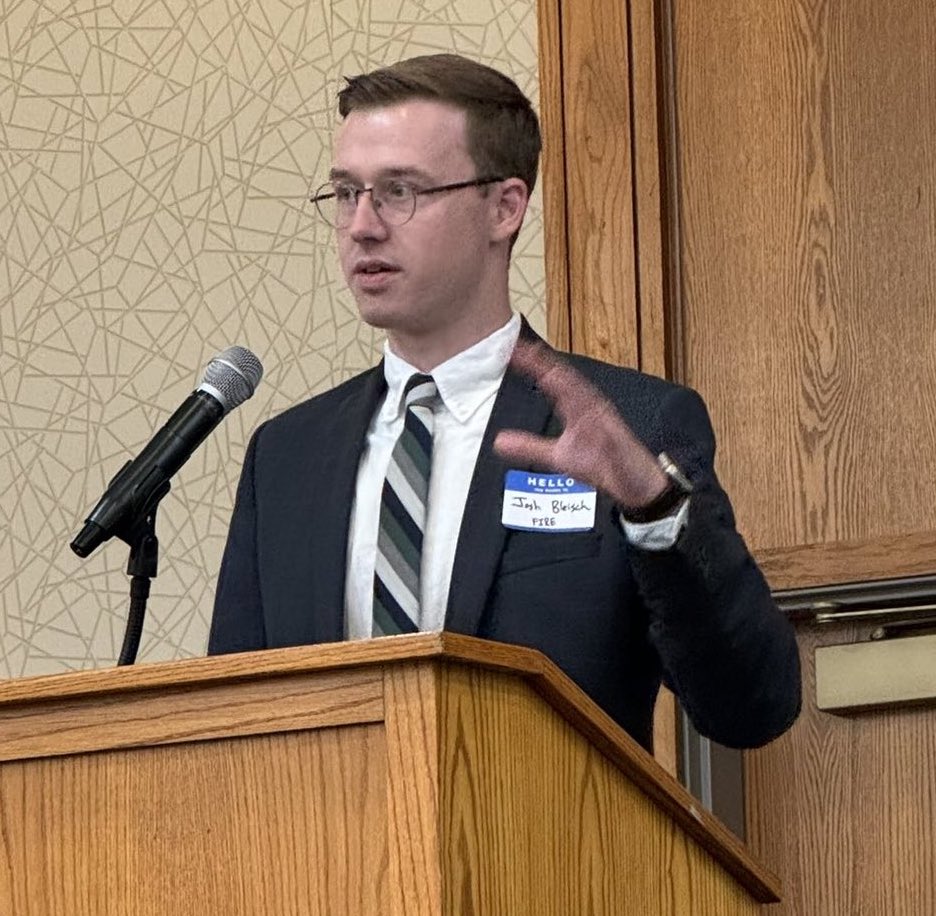
Attorney Joshua Bleisch from FIRE presenting on Academic Freedom in the Courts.
Dr. David Albert and Lobbyist Beaman Floyd discuss the higher education priorities in the next Texas Legislative session.
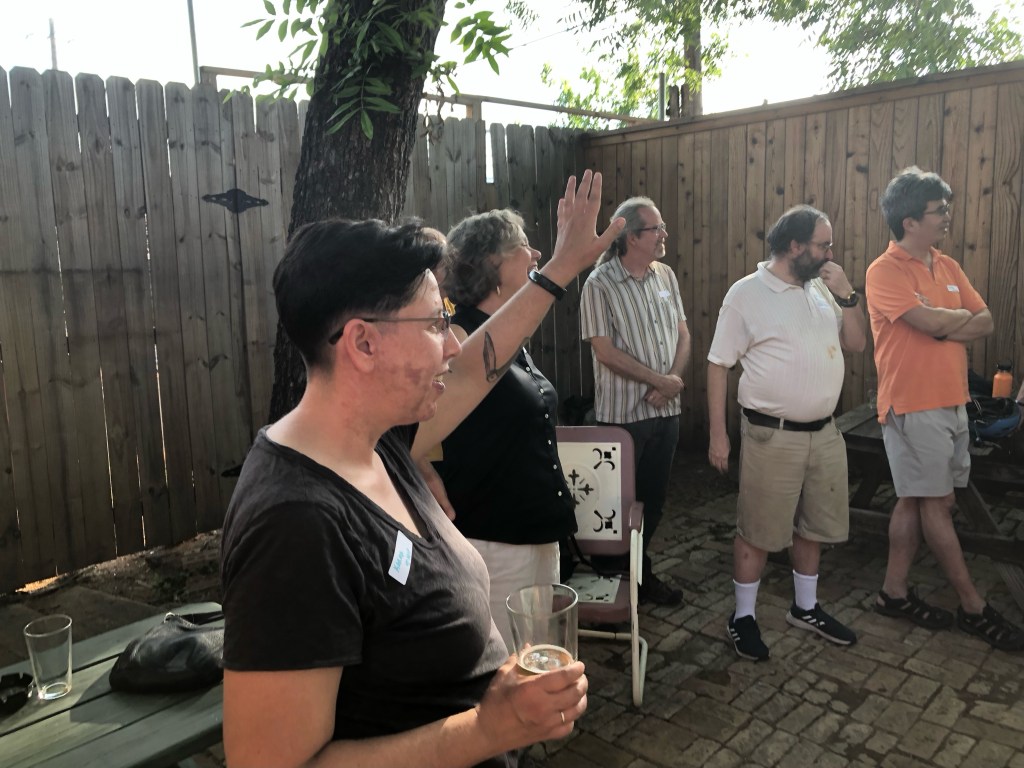
Dr. Leslie Bary, Secretary of the Louisiana AAUP Conference, asks a question during the panel on the upcoming Texas Legislative session,
Agenda
9:00 a.m. Welcome 9:30 a.m. Shared Governance panel: Donny Leo, Tony Villanueva, and Sandra Jordan 10:45 a.m. Break 11:00 a.m. Academic Freedom panel: Teresa Klein, Donny Leo, and Sandra Jordan 12:30 p.m. Lunch / Professor David Rabban to speak about his new book Academic Freedom: From Professional Norm to First Amendment Right 1:30 p.m. Faculty Rights questions for attorney Frank Hill 3:30 p.m. Break 3:45 p.m. Academic Freedom in the Courts: Joshua Bleisch, FIRE attorney 4:45 p.m. Texas Legislative Session: Beaman Floyd and David Albert 5:45 p.m. Wrap up
Speakers from all over the state and beyond are gathering to present this unique opportunity for faculty. Among the speakers:
Dr. David Albert is the Texas AAUP-AFT Vice President for Central Texas and the Austin Community College AFT Local President. He is also a Professor of Government at ACC.
Joshua T. Bleisch, an attorney with the Foundation for Individual Rights and Expression (FIRE), will discuss Academic Freedom in the Courts.
Frank Hill, a higher ed employment attorney currently representing about 20 Texas faculty, will answer legal questions from attendees.
Dr. Sandra Jordan, Chief of Staff, Southern Association of Colleges and Schools (SACS) Committee on Colleges which accredits public and private colleges and universities in Texas and beyond, will participate on the academic freedom and shared governance panels.
Dr. Teresa Klein is the Texas AAUP-AFT Vice President and the Del Mar College AAUP Chapter President. She is also a tenured Professor of Psychology and former Faculty Senate President at Del Mar College. She is also a TFA officer.
Donny Leo has many years of experience actively advocating for academic freedom, shared governance, tenure, and faculty rights at community colleges and universities.
Professor David Rabban, the Dahr Jamail, Randall Hage Jamail, and Robert Lee Jamail Regents Chair in Law, Distinguished Teaching Professor at The University of Texas at Austin, will talk about his new book Academic Freedom: From Professional Norm to First Amendment Right. Prof. Rabban also served as Counsel, General Counsel, and Academic Freedom Committee Chair of the National AAUP.
Tony Villanueva is the Texas AAUP-AFT Vice President for South Texas. He is also a tenured Professor of Psychology at Palo Alto College in San Antonio where he served as Faculty Senate President 2019-2021. He is the convener of a new AAUP-AFT chapter for Alamo Colleges, which includes Palo Alto College and four other community colleges.
About AAUP. Founded in 1915, we champion academic freedom, advance shared governance, and organize all faculty to promote economic security and quality education. Here’s a link to join and several reasons to consider joining. Membership is kept confidential. AAUP has 42,000 members and is affiliated with AFT with 1.8M members including 300,000 in higher ed. AFT is part of AFL-CIO with 12M members. Follow Texas AAUP-AFT on X @TexasAaup and @aaup_utAustin.
About TFA. We support the freedoms of all faculty and staff, and vigorously supports its members. We are stronger together and want to advocate for you! Here’s a link to join TFA and several reasons to consider joining. Membership is kept confidential. TFA is affiliated with the Texas State Teacher’s Association, which is affiliated the 3M members of the National Education Association (NEA). Follow TFA on X @TXFacultyAssoc.
We’re inviting all part-time and full-time faculty members from community colleges, public universities, private universities, and health-related institutions to complete a survey to assess academic freedom and employment issues for faculty at public and private institutions, including the impact of State Laws.
We would like to hear from adjunct, lecturer, instructional, clinical, research, tenure-track, tenured, and other faculty members in Alabama, Arkansas, Florida, Georgia, Kentucky, Louisiana, Mississippi, North Carolina, South Carolina, Tennessee, Texas, or Virginia.
The survey will accept responses until Friday, August 30, 2024, at 4pm CT. It’s the same link for everyone: https://forms.gle/hZZtTydfodHiCkEa7.
Take the 2024 AAUP Faculty in the South Survey
Completion time is about 10 minutes. It’s the same link for everyone.
A few days after the survey closes, the organizers will release its results through media and other platforms. Leaders of the AAUP will maintain control of the results database. We may share overall results and the full database of answers with administrations, faculty, and the media. No information about your personal identity is being collected. All questions are optional, but please answer as many as you feel comfortable with.
Please forward this message to other colleagues and post on social media.
About AAUP. We champion academic freedom, advance shared governance, and organize all faculty to promote economic security and quality education. Here’s a link to join AAUP and several reasons to consider joining. Membership is kept confidential. Follow Texas AAUP on X @TexasAaup and @aaup_utAustin.
About TFA. We support the freedoms of all faculty and staff, and vigorously supports its members. We are stronger together and want to advocate for you! Here’s a link to join TFA and several reasons to consider joining. Membership is kept confidential. Follow TFA on X @TXFacultyAssoc.
I hope that you’re finding the time to prepare for the fall semester and November elections. For daily updates, follow us on X at @TexasAaup and @aaup_utAustin.
Today’s Texas AAUP-AFT update is on SB 17 Syllabus Language, Fall Outreach, Voter Registration, and Academic Freedom Project, Higher Ed Summit, and Fall Texas AAUP-AFT meeting. Please feel free to share this email message to others.
SB 17 Syllabus Language
On Jan. 9, 2024, a few days after SB 17 took effect, Texas AAUP hosted a panel on “Guidance on anti-DEI SB17 and its exceptions for academic course instruction, scholarly research, and creative works”. At the panel, Texas AAUP presented the following course syllabus language to affirm the exception of academic course instruction in SB 17:Texas Senate Bill 17, the recent law that outlaws diversity, equity, and inclusion programs at public colleges and universities in Texas, does not in any way affect content, instruction or discussion in a course at public colleges and universities in Texas. Expectations and academic freedom for teaching and class discussion have not been altered post-SB 17, and students should not feel the need to censor their speech pertaining to topics including race and racism, structural inequality, LGBTQ+ issues, or diversity, equity, and inclusion.
With the elections on Nov. 5, please consider organizing or contributing funding for voter registration drives. Coordinating with student orgs can be quite effective. Voter registration in Texas is cumbersome. It is by paper form and the person registering has to complete it. The Texas Secretary of State site has a voter registration starter page that will generate a form to print, sign, and mail. The deadline to register is Oct. 7. Here’s more info on voting in this election from The Texas Tribune, a nonprofit and nonpartisan news organization.
Academic freedom project
Texas AAUP-AFT Officer Miriam Sobre is proposing to create a one-stop shop for faculty who want to know if their current or planned activities infringe on state laws or their campus policies. A committee of faculty would create the content. Others would develop Wiki and App versions. The project would also curate resources on advocacy, academic freedom and shared governance. Please email Miriam Sobre at m.sobre.denton@gmail.com if you’d like to contribute to the project. We need you!
Upcoming Events
Higher Ed Summit will help faculty understand their rights, navigate the new higher ed landscape, and advocate at the next Texas Legislature. The summit has free registration and will be held Saturday, Sep. 14, 2024, 9am-6pm, in Beaumont at the Elegante Hotel. On the agenda, topics include shared governance, academic freedom, faculty rights, free speech, legislative advocacy, and faculty senates. Presenters include Texas AAUP-AFT Officers David Albert, Brian Evans, Teresa Klein, and Tony Villanueva; former AAUP General Counsel David Rabban; TFA attorney Frank Hill; FIRE attorney Joshua T. Bleisch;SACS Chief of Staff Sandra Jordan on accreditation; and Lobbyist Beaman Floyd. Please bring other faculty with you. We have a special room rate of $89 at the Elegante Hotel 409-842-3600. RSVP to TFA President Pat Heintzelman at tfa.president@texasfacultyassociation.org.
Fall Texas AAUP-AFT meeting will be on Saturday, Sep. 28, 2024, 8:30am-1:00pm in San Marcos, Texas, in person and on Zoom. The tentative agenda includes academic freedom and shared governance; faculty rights and representation; political interference; organizing, advocacy, and political action; campus reports; and faculty survey results. Former AAUP General Counsel David Rabban will speak on academic freedom. In-person attendance is only open to AAUP and AFT members– please RSVP to Brian Evans (Texas AAUP-AFT President) at aaup.texas@gmail.com. Registration is free. You can reserve a room at the conference hotel at a discounted rate using our room block. Anyone can attend by Zoom.
For faculty facing investigations, discipline, or dismissal, you are not alone! We have your back. We’ll be available to
go with you at any meeting to advocate for you
give advice on navigating your situation
provide a list of attorneys for information purposes
In these settings, administrators and investigators are not on your side.
As a tactic, administrators and investigators will
call a meeting to “ambush” a faculty member with allegations, and many faculty will react to clear their name and overshare.
choose to say things that are not true or misleading to see what information you would share.
Record all meetings with administrators and investigators. Texas is a one-party recording state. You don’t have to notify others or obtain their permission. More info.
Your work email account is not private because administrators can obtain access. Use private email accounts and secure messaging (e.g. WhatsApp or Signal) for non-work matters.
Backup important email messages and files onto non-work accounts if permitted. A college or university can disable your access to work e-mail and other work platforms at any time.
$8M Professional Liability Coverage including $35k in Legal Action Trust to respond to criminal investigations
Legal defense fund for employment matters. Legal costs split 1/3 Texas AAUP-AFT, 1/3 Texas AFT and 1/3 National AFT. Texas AAUP-AFT will need to build its legal defense fund.
Director of Public Affairs & Legislative Counsel, Patty Quinzi, JD
New Texas AAUP-AFT Dues Structure, Brian Evans
Now that Texas AAUP-AFT is an AFT Local of Texas AFT, we’ll be updating our dues model to build our legal defense fund and help cover the cost of Texas AFT staff and productivity tools.
New dues combine dues for Texas AFT, National AAUP, National AFT:
$451/yr for academic income above $80k (AAUP bands 7-9)
$305/yr for academic income between $50k-80K
$155/yr for academic income $50k and under
New Texas AAUP-AFT registration link launched Sept. 27, 2024. Payment is monthly through a bank draft. More manageable payments than the usual annual renewals for AAUP membership.
2. Political Interference, Legislative Advocacy & Political Action Panel
Anthony Elmo, Texas AFT Director of Political Organizing, advocates for shared interests of K-12 and Higher Education expressed in the Texas AFT Educator’s Bill of Rights, and directs the Committee on Political Education (COPE) to give info about voter registration, voting, and candidate positions on public K-12 and higher ed
Christina Das, NAACP Legal Defense Fund Civil Rights Attorney.
Q: Ok to encourage students in the classroom to register to vote?
A: Yes for all eligible voters. A QR code given to learn more.
Teresa Klein, Texas AAUP-AFT VP, spoke about Project 2025.
Prof. David Rabban is at the UT Austin Law School. He served as AAUP General Counsel 1998-2006 and Chair of AAUP Committee A on Academic Freedom and Tenure from 2006-2012. “His teaching and research focus on free speech, higher education and the law, and American legal history.” [Ref]
Academic Freedom is necessary for the function of a professor
Peer review feature of academic freedom.
What is the relationship between academic freedom and the general political expression outside their expertise
A professor cannot do their job to have findings that offend someone leads to their firing
Extending Academic Freedom to political speech
The whole point of academic freedom is
Professors should have the rights as anyone else
Societal interest in the production and dissemination of knowledge
Professors in Classics should be able to apply lessons to contemporary topics
First five investigations by AAUP after 1915 involved protected speech
1917: Donor said they would give $10M to Harvard if a certain faculty member who opposed US involvement in World War I would be dismissed. The Harvard President separated academic freedom from political speech, and said both should be protected.
Legal cases of academic freedom began in 1950’s.
Sweezy v New Hampshire 1957 – Academic freedom is a First Amendment right, and differentiated First Amendment free speech from academic freedom
Keyishian v Board of Regents – Academic freedom is a special concern of the 1st amendment – seminal case (cited many times)
First amendment protections apply to state (government) actors, not private actors, but some private universities voluntarily give First Amendment protections
Hundreds of lower court decisions say academic freedom is a First Amendment Right
Generally – applies to the content of academic speech.
Some rulings limit academic freedom to content.
Academic freedom protects legitimate pedagogical decisions for your course
Giving materials and instructions to the students in a classroom to register to vote is not likely protected by academic freedom.
Discussion of intramural issues usually protected by academic speech.
Outside speech and political speech not necessarily academic freedom, but have free speech rights.
Rabban’s argues the following two statements should be incorporated into First Amendment Law
Even though legal cases recognize academic freedom, courts do not always use academic freedom as a criterion to decide a case.
Determining what is protected speech of the professor
Employee Speech Juris Prudence – speech rights of public employees
Garcetti v Ceballos – “speech of public employees not protected when in the course of normal job duties” – BUT does not apply decision on public employee speech to faculty academic speech
Other Court of Appeals cases recognize Garcetti exception:
Meriweather v. Hartop 2021
Pickering standard – two-prong weight
Professor’s speech rights outweighs right of institution for efficient operation.
Issue is of Public Concern
There is a public interest in the professor’s dissemination of knowledge.
Questions
Has 5th circuit recognized academic freedom as free speech?
Ok to encourage students in the classroom to register to vote? Not likely protected by academic freedom
How much speech related to university governance is protected? Conflicting decisions by the courts.
Common Themes in AAUP Campus Chapter Reports
Issues mentioned by AAUP chapters at public campuses
Compression– faculty of a lower rank making higher salary
Administrative bloat– exponential increase in number of administrative positions along with excessively high salaries and raises for administrators (20% raise vs. 2% for faculty)
Low and high enrollments affecting campus budgets
Faculty workload policies
Increased expectations for research without appropriate administrative support or reduction in teaching load
General counsel and compliance officers having unchecked power
Collegiality. For faculty, AAUP recommends evaluating teaching, scholarship, and service. Collegiality should not be separate but can be included in the three categories. AAUP Statement.
Dual Enrollment Courses
must comply with higher ed laws and campus policies, but many K-12 students, parents, and principals are expecting compliance with K-12 laws and K-12 school policies
faculty are being reassigned to serve dual credit against their will, and certain faculty are being excluded with due process
Trinity University AAUP Chapter – Tahir Naqvi (President)
University of Dallas AAUP Chapter – John Osoinach (President)
Texas A&M System
Prairie View A&M AAUP Chapter – David Rembert (President)
Tarleton State AAUP Chapter – Reggie Hall (not present)
Texas A&M AAUP Chapter – Tom Blasingame (President)
Texas A&M Corpus Christi AAUP – Kelly Bezio (President)
Texas A&M San Antonio AAUP Chapter – Martha Saywell (VP)
West Texas A&M AAUP Chapter – Ryan Brooks (President)
Texas Southern University – Cary Wintz (not present)
Texas State System
Texas State University AAUP Chapter – Patrick Smith (Convener)
Sam Houston State University AAUP Chapter – Mike Vaughn (VP)
Sul Ross University AAUP Chapter (not present)
Lamar University AAUP Chapter – Pat Heintzelman (President)
Texas Tech University AAUP Chapter – Andrew Martin (President)
Texas Woman’s University AAUP Chapter – Diana Hynds (President)
University of Houston AAUP Chapter – Daniel Morales (not present)
University of North Texas – Todd Moye (not present)
UT System
UT Arlington AAUP Chapter – Penny Ingram (President)
UT Austin AAUP Chapter – Polly Strong (President)
UT Dallas AAUP Chapter – Simon Fass (President)
UT MD Anderson AAUP Chapter – Bill Wierda (not present)
UT Permian Basin – Derek Catsam (not present)
UT Rio Grande Valley AAUP Chapter – Dora Saavedra (President)
UT San Antonio AAUP Chapter – Alistair Welchman (not present)
Additional Information on Agenda Topics
About AAUP. AAUP advocates
for free inquiry, free expression, and open dissent, which are critical for student learning and the advancement of knowledge
against infringement on academic freedom and its safeguards of tenure, due process, and shared governance
Since 1915, AAUP has been the central organizing force in higher ed in its widely adopted principles on academic freedom and shared governance and its 42,000 members and 500 campus chapters championing these principles.
Campus and Legislative advocacy from its 66,000 members & 40 staff
Workplace protections including liability coverage and legal aid
TexasHigher Ed ecosystem. Our public and private colleges and universities collaborate in teaching, research, and community outreach. Graduates of our private institutions become faculty members at our public institutions, and vice-versa. From our Texas AAUP survey in Fall 2024, faculty at public and private institutions reported the political climate in Texas was interfering significantly with recruiting and retaining faculty. We’re in this together!
SB 18. How do I fire thee? Let me count the ways… Although SB 18 defines 10 reasons for regular and summary dismissal for tenured faculty, public colleges and universities have been using SB 18 to dismiss non-tenure track and tenure-track faculty as well. Of the 10 reasons, seven are vague or undefined. All reasons can be weaponized by administrations. SB 18 is now in law as Texas Education Code 51.942.
SB 17 bans certain DEI programs and practices in public colleges and universities. Although SB 17 has exceptions for academic course instruction and research, it has a chilling effect on both. Certain discussions about DEI by faculty outside academic course instruction and research can be construed as training, which can lead to termination under SB 17. Several administrations are over-complying with SB 17. Texas AAUP provides guidance on anti-DEI SB17 and its exceptions for academic course instruction, scholarly research, and creative works.
Shortly after our Texas AAUP voted to affiliate with Texas AFT in March, Texas AFT hired two new full-time organizers for Texas AAUP, Alvaro Chavez (Lead Organizer) and Amanda Garcia (Organizer), who started July 1st and are pictured below outside the Texas AFT Headquarters in Austin. Alvaro is based in the Rio Grande Valley and Amanda is based in Austin. In addition, Alejandro Pena is helping Texas AAUP members with Government Relations and Policy Analysis. We in Texas AAUP also have access to the 40 full-time staff at Texas AFT, including lawyers, media specialists, and lobbyists. This will be critical to help us organize in the fall and spring to advocate on our campuses and at the Texas Legislature.
Planning Fall Outreach on Your Campus
For the fall, I’d like to ask AAUP members on each campus to plan a fall outreach event. It could be presenting AAUP principles at faculty orientation; hosting a speaker/panel on academic freedom, shared governance, or the upcoming Legislative session; or forming an AAUP chapter if you don’t have one. Please contactYour AAUP chapter president to see how you could help, or contact me on how to start an AAUP chapter. Here’s a list of the AAUP chapters in Texas.Texas AAUP VP for your region (North, East, West, South, Central). Here are names and contact info for our Texas AAUP Officers. Texas AFT Organizers for Texas AAUP, Alvaro Chavez (achavez@texasaft.org) and Amanda Garcia (agarcia@texasaft.org). AAUP chapter presidents, Texas AAUP VPs, Texas AFT organizers, and I have been brainstorming about fall outreach during our meetings held every three weeks.
Next Texas Legislature Convenes January 16, 2025
Next Texas Legislature will be from Jan. 16 to June 2, 2025, and Legislators can start filing bills as soon as they have been certified as elected in the November election. Legislative priorities include stifling free speech, suppressing academic freedom, restricting shared governance, and silencing faculty. Bills will severely limit faculty senates or eliminate them altogether. We also anticipate bills to expand the bans on DEI student services and other DEI activities, and weaken tenure and other faculty employment protections.
Project 2025 Higher Ed Priorities
Project 2025, organized by the Heritage Foundation in consultation with “more than 100 conservative organizations” including the Texas Public Policy Foundation, contains national Higher Education Priorities includingprivatizing student loansdefunding area studieseliminating federal oversight of institutional accreditation bodies, teaching American exceptionalism, banning “gender ideology and critical race theory”, disbanding the US Dept. of Education altogether. Institutional accreditation bodies currently require an institution to have safeguards for academic freedom and an implementation of shared governance. For context, please see Isaac Kamola, Manufacturing Backlash: Right-Wing Think Tanks and Legislative Attacks on Higher Education, 2021–2023, AAUP Center for Academic Freedom.
Upcoming Events
Please consider participating (and inviting colleagues to participate) in the following opportunities for training in academic freedom, shared governance, and organizing to help us advocate on our campus and at the Legislature:
July 27, 9am-1pm, Texas Faculty Association Training on Faculty Rights and Grievances, Attorney Frank Hill, Zoom link. Here’s a faculty lawsuit vs. Dallas College being argued by Frank Hill. Hosted by Pat Heintzelman (TFA President). Aug. 1-4, National AAUP Summer Institute, Wayne State University, in Detroit, Michigan. In person only. Aug. 6: AFT Winning Issue Campaigns. RSVP. 3-5pm ET. Zoom. Training is complimentary for union and non-union members alike. Sep. 14, 9am-5pm, Higher Education Summit, Beaumont, Texas. RSVP Pat Heintzelman (TFA President) at tfa.president@texasfacultyassociation.org. Sep. 28, 9am-1pm, Texas AAUP-AFT Fall Meeting, San Marcos, Texas, in person and on Zoom. RSVP Brian Evans (Texas AAUP President) at aaup.texas@gmail.com
Texas AAUP-AFT Delegation – Brian Evans, Pat Heintzelman, Jim Klein, Teresa Klein, Polly Strong, and Cary Wintz
South Carolina AAUP Delegation – Mark Blackwell, Dave Bruzina, Carol Harrison, Adam Houle, Sharon O’Kelley, and Shawn Smolen-Morton
June 20, 2024
The Texas delegation at a reception after a good day of discussing collective action for higher education. From left to right, Jim Klein, Pauline Strong, Cary Wintz, Pat Heintzelman, Brian Evans, Teresa Klein, representing AAUP Members at Del Mar College, UT Austin, Texas Southern, and Lamar University. Brian, Jim, and Teresa are Texas AAUP Officers.
The 2024 AAUP Conference and Biennial Meeting, which is held every other year, offered seminars and panel discussions on academic freedom and shared governance as well as voting on constitutional amendments and resolutions. Every four years, including 2024, officer elections are held. About 200 people attended the June 13-16 meeting in Washington, DC. Polly Strong and Lauren Gutterman tweeted updates @TexasAAUP.
Here’s a quick summary from the seminars and panel discussions:
UCLA Law Professor Taifha Natalee Alexander presented their CRT Forward Project that tracks policies and laws for K-12 and higher ed to ban CRT and related issues such as banning DEI. They track Lexis and Westlaw legal databases as well as 4,000 newspapers, and publish info at an eighth grade level to reach a wide audience.
Dr. Patricia Okker, President of New College in Florida until removed by board members appointed by Gov. DeSantis. New College is a public Liberal Arts College. Pres. Okker says attacks on academic freedom are political theater. Shift from “defend” to “champion” “academic freedom” and share positive outcomes of academic freedom grounded in student experiences. The reason for academic freedom is the search for truth. Let’s take back the phrase “search for truth”.
Mark Bostic, Director AAUP Organizing and Services, led a discussion with state conferences. Conference agendas, efforts, and structures vary widely in reaction to state politics. The AFT-AAUP affiliation has benefited some conferences like Texas and distressed conferences like Oregon, but has had no effect on conferences like South Carolina. Many Collective Bargaining Chapters report redundancy of services, differences in mission, and increasing dues due to the AFT affiliation.
Malori Musselman, AAUP Organizer, led a discussion with advocacy chapters. Members shared organizing struggles, conflicts with administration, and successes. Several chapters formed recently or are in the process of forming, and were seeking advice. Malori offered tips and directed chapters to training opportunities.
Here’s a quick summary of committee reports:
Treasurer Rudy Fichtenbaum reported declining revenue, increasing expenses, and drawing from cash reserves to balance the budget. Please see the Appendix.
AAUP Vice-President Paul Davis reported on organizing. With support from the AFT, 16 new AAUP Collective Bargaining Chapters have been founded in the last two years, representing 4,000 new members. AFT spent $12M in the effort, and AFT and AAUP will split the dues equally. Paul stressed the conversion of advocacy chapters to collective bargaining and the affiliation’s focus on large institutions.
Here’s a quick summary from the Assembly of Delegates (94 delegates):
Elected President Todd Wolfson (wolfsont@gmail.com), VP Rotua Lumbantobing (rltobing@gmail.com), Secretary-Treasurer Danielle Aubert, and At-Large Members Chenjerai Kumanyiki and Paul Davis. Here’s an interview with Todd & Rotua. Their four-year terms began June 16, 2024.
Passed a Constitutional Amendment to allow the Association to compensate officers and Council members by compensating their institutions for release time from teaching or other assigned duties or by compensating them directly at an equivalent rate for their participation in Association matters. The Constitution continues to allow reimbursement “for reasonable expenses incurred in connection with the performance of their duties” for officers and Council members.
Advocated with the AAUP Council to lift the staff hiring freeze ordered by Interim Director Nancy Long in January. At present, 30 of 60 staff positions remain unfilled. Hardest hit units are organizing, communications, membership, and government relations. This affects the work of the AAUP and impedes the ability of members and chapters to advance the mission of the AAUP.
After the above discussion of the impact of the staff hiring freeze, several AAUP members formed an ad-hoc committee. The committee’s first action was to ask the newly elected leaders to address the severe staff shortage on June 19, 2024. The committee is Jill Dumesnil, Brian Evans, Emily Ford, Johanna Foster, Nicole Gallagher, Afshan Jafar, Bethany Letiecq, Ernesto Longa, Harmon Oskar, Cristina Restad, and Saranna Thornton.
AAUP delegations from Georgia, Kentucky, Louisiana, North Carolina, South Carolina, and Texas met to discuss plans to organize together. All of our Legislatures will reconvene in January. We hope to hold virtual meetings as well as a hybrid biennial meeting starting Summer 2025 to alternate with the biennial National AAUP Meetings. Virginia AAUP will also be joining.
We would like to thank Irene Mulvey for her service as AAUP President 2020-2024. We are grateful for her leadership including:
Affiliating with the American Federation of Teachers (AFT)
Providing AAUP guidance during the pandemic
Expanding Committee A on Academic Freedom and Tenure to include disciplinary expertise in racial equity
Turning AAUP into a more nimble organization with faster responses to crises
AAUP membership is about 42000, with 32000 in collective bargaining units and 10000 in advocacy chapters. In Texas and across the South, all of our chapters are advocacy chapters. States that allow collective bargaining units in the public sector might have collective bargaining and advocacy chapters. Ohio has both. Florida only has advocacy chapters.
Appendix: Treasurer’s Report
The fiscal year is the calendar year. Treasurer Rudy Fichtenbaum reported declining revenue and drawing from cash reserves to balance the budget.
Revenue
2023
2022
2023 vs. 2022
Coll. Barg. Dues
6,222,562
6,376,861
(154,299)
Advocacy Dues
1,733,077
1,799,693
(66,616)
AFT Support
1,807,127
1,522,917
284,210
Other Revenue
195,796
352,357
(156,561)
TOTAL
9,958,562
10,051,828
(93,266)
AFT Support was budgeted at $3,769,381 in 2023 per the AAUP affiliation agreement.
Expenses
2023
2022
2023 vs. 2022
Salaries & Benefits
5,497,811
5,246,762
251,049
Contracted Services
1,099,768
842,860
256,909
Joint Organizing
38,707
124,079
(85,373)
Business
236,314
443,155
(206,841)
Meetings & Travel
647,610
713,410
(65,800)
AFT Per Capita
1,965,408
909,176
1,056,232
Other
1,116,409
1,038,389
128,020
TOTAL
10,652,027
9,317,831
1,334,196
In Fiscal Year 2023, AAUP had 17,112,114 in Assets and 6,366,405 in Liabilities, which gives 10,745,708 in Net Assets.
By Gary L. Bledsoe, Esq. thanks to Ms. Alberta Phillips and Dr. Angela Valenzuela for their feedback April 15, 2024
Introduction
In an effort to motivate conservative voters and antagonize and divert progressives and minorities, the far right conceived the idea of going after diversity, equity and inclusion (DEI) programs and initiatives (Rufo, 2023). To do that, they reached for the playbook they used to scare the public and degrade the scholarship regarding Critical Race Theory (CRT). Just as they promoted a deeply false narrative defining and describing CRT, they launched a similar campaign against DEI. Consequently, extreme states like Florida and Texas led the way in passing laws aimed at eliminating or severely cutting back DEI efforts in government and higher education. Utah’s Republican conservative governor who presents as more reasonable or moderate in his politics—perhaps pressured by the more extreme wing of his party—signed such a bill into law. Sadly, many other states are expected to adopt similar laws in the near future (Bryant & Appleby, 2024).
Drawing on our civil rights heritage and struggle, the purpose of this brief is to provide the policy and political landscape of this right-wing attack on higher education, together with ideas on protecting individuals, on the one hand, and what organizations can do in the wake of these attacks, on the other.
Policy and Political Landscape
In Texas, when Senate Bill 17 (SB 17) was laid out during the regular 88th Texas Legislative Session by its GOP sponsor, Senator Brandon Creighton, Senator Royce West, a stalwart and highly respected state Senator, engaged Senator Creighton in a conversation that many felt revealed the bill sponsor could not or would not define DEI or say what it was, even though the bill had been filed and was being presented to a Senate Committee. They then discussed getting someone to come before the Committee who knew what DEI was. Clearly the Senator had not actually written this bill. The New York Times has published an article that demonstrated how racial bias was a motivating factor for some of the bill’s proponents (Confessore, 2024).
The forces that seek to eliminate and thwart DEI are organized (Confessore, 2024). They have vast resources to dismantle such programs. Many nonprofits like those described by Jane Mayer in Dark Money (2017) have been created and billionaires who oppose affirmative action, equality in government and education as well as diversity, equity, and inclusion—and who have a disdain for the 14th Amendment—have joined together to fund them.
It is worth noting what the true and unspoken agenda is of these groups: To turn back DEI in order to maintain and elevate White privilege within government and higher education systems where they are not only over-represented but manifest higher completion rates than students of color (Carnevale & Strohl, 2016). Higher completion means higher earnings, exacerbating intergenerational privilege and educational advantage that as parents, they later pass on to their children (Carnevale & Strohl, 2016). In contrast, DEI aims to help counter white privilege for poor and working class whites, minorities, disadvantaged citizens such as veterans or first-in-family to attend college students and others. In other words, these efforts seek to maintain the status quo and actually make middle- and upper-class white privilege the law of the land. The good people who occupy the positions seeking to broaden opportunity are inconsequential casualties of this anti-DEI movement.
Efforts to level those playing fields, which soared following the George Floyd killing, became the focus of those conservative groups. Their tactics included promoting false statements, including that DEI programs were illegal (Williams, 2023). Ultimately in Texas, after the latter was proved false, they settled on another false narrative, stating that DEI initiatives provided privilege or “benefits” to certain populations, such as African Americans, Latinos, and LGBTQ+ people. In other words, DEI equates to “reverse discrimination” against straight, white people. Hence, SB 17 was the “fix” to a made-up problem. Throughout the 88th Texas Legislative Session, no evidence was provided to back up the claim by legislators that White people were being displaced or disadvantaged by DEI programs or initiatives. And since the legislative session, we have seen gross overreach where Universities are being bullied into cutting people and programs well beyond the scope of the actual law. Every effort is being made to eliminate programs, activities, and personnel who might assist or aid minority or non-traditional students, while programs, activities, and personnel that are responsible for supporting or reinforcing white privilege are allowed to remain.
The landscape is dreary. In some states such as has been reported regarding Florida, they have already fired all DEI employees (Lawson, 2023). In other states like Texas, they have fired some, and demoted or reassigned others into positions that may not be secure in the future, but others have been terminated or laid off in some Universities including many at the University of Texas at Austin. Moreover, student organizations have been adversely impacted (Srivastava, 2023). But the fallout also has created an environment of fear, anxiety, and suspicion among Faculty and Students of Color in Texas universities (Zamora & Valenzuela, 2024). We have heard from a number of students and professors that they have considered or are presently considering leaving their campuses for more welcoming places elsewhere. A report by the American Association of University Professors (2023) indicates as much (also see Mangan 2024a).
As Martin Luther King once said, when you hear the bell tolling you need not ask “For whom the Bell Tolls”, because he says, “It tolls for thee.” When they come for each of us individually, we must realize it is a very difficult task for us to prevail individually. With all its resources, the other side has people paid to identify potential targets around the country and to generate momentum in each and every case. As of now, they have DEI and equality advocates and allies beat on the ground game. They have media that are not worried about balance or fairness that will run with their claims without analyzing or fact-checking them, and university officials who in wanting to keep their own positions, genuflect and sacrifice the good and honorable people who have done nothing wrong and have done their jobs with integrity.
What happened at Harvard University recently is a prime example of an entire ecosystem of conservatives, including their media and elected officials, ganging up on its first African American President, Claudine Gay. Individuals, by and large, do not have the financial resources, media attention, or political power to engage in such fights. Now, we are seeing attack tactics by conservatives evolve by invoking “plagiarism.” This alleged “plagiarism” issue has been identified as fertile territory. It was successful in Gay’s case. We no doubt will hear more and more about that. Think about this, the conservative media publishes a likely nefarious story about someone being guilty of plagiarism, the person is then put on leave if they are a member of the staff, professor, or top official and informed that they must fight to maintain their tenure. Justice can be attained, but in my estimation, the internal systems in many if not most universities will yield to far-right pressures unless there is formidable opposition. Regardless, the damage is done by discouraging future candidates of color from applying for such positions (Mangan, 2024b).
This means that each and every individual who is wrongfully attacked on nefarious charges should be connected with a strong and viable organization, and not one that will crater to the needs and wants of an administration.
In this paper I outline ideas and activities that we should consider to put ourselves into an effective position to prevail in this fight. Let us remember how the American colonists were outnumbered by British regulars and mercenaries who had superior artillery and training, yet the American colonists, with substantial help from Black soldiers, were able to prevail. In the 1940’s, 50’s, and 60’s Black leadership successfully attacked Jim Crow, and at least for a time, they were able to subdue it despite the vast institutional strength on the other side. They did this with a diverse group of allies of all different races, political affiliations, sexes or sexual preferences who all helped fuel the movement. This is the spirit we must undertake in the “New Jim Crow” era. We never know who the champion of our cause might be, it might be those among us who is least expected (Bass, 1981).
Protecting the Individual
The individual should become aware that not everyone is their friend and that frequently when people come after you for one reason, they might find another and more legitimate reason to take action. As my wife says to me all the time, when you know someone wants to shoot you with a gun they brought to the fight, don’t be foolish and supply them the bullets. Here are some suggestions:
Don’t use university equipment to communicate or address your personal issues. Universities consider anything on their computers, even your email communications, to be their property and thus, not confidential so they will review those emails whenever they desire to do so;
Don’t use university WIFI because they sometimes take positions that the use of their WIFI on any device gives them the right to view everything on that device;
Don’t ever lose your temper and put yourself in jeopardy for an insubordination charge; If you disagree or oppose an action, say so in neutral terms, language, and behavior; or write a respectful email on your device and blind copy yourself. Where appropriate backup your systems.
Remember that not everyone is your friend. You should be very careful who you talk to about details regarding what is happening around the university as there certainly will be “enemies” and perhaps even “friends” who are looking for examples of differential treatment to report to their bosses or superiors. Martin Luther King Jr. had a similar experience in Albany, Georgia where one of the Black leaders went to speak with the Sheriff every night after meeting with Dr. King and other leaders to let the Sheriff know of their plans. Johnnie Cochran discovered in the Geronimo Pratt trial that his co-counsel went to talk with the District Attorney each night after the defense lawyers had met in order to inform them of their strategy. This is another reason for you to become a member of a reputable organization that will stand with you through difficult times. You should be able to confide in and trust them. Get into the practice of documenting things using your own personal devices and equipment. The time might come when you need that documentation to counter false allegations or lies.
Dot your i’s and cross your t’s every day;
Never send an official response while you are angry if you can avoid it. Remember that the matter could end up in litigation and there will be many different kinds of persons reviewing it;
Review university employment rules and get copies of them for your use if the need arises;
Maintain copies of any important documents to which you have legitimate access. Don’t be put in the position of being locked out of your office, files, computer records, or being walked out by security. Think about having a backup device or thumb drive because once litigation or administrative procedures start, the documents you need are somehow no longer available or cannot be found;
Connect with an organization that you can trust and that will be with you in the fight such as some Faculty and/or Staff organizations, or associations like the NAACP, LULAC, AAUP, or labor unions;
Familiarize yourself with your state law and university policy to determine what the requirements or prohibitions might be for the use of electronic equipment; and
Talk to people in your community about lawyers who are courageous and trustworthy and who will fight to protect your rights. The National Employment Lawyer’s Association and the National Bar Association are two organizations of note that might have lawyers nearby who might meet these criteria.
These are just some things an individual might do to put themselves in the best position possible, knowing that even by doing this you will remain an underdog. Hence, the importance of belonging to an organization that can provide cover.
What the Organizations Can Do
Many articles have been published telling us this is a national, state, and local right-wing effort, and we have seen how states like Florida, Texas, and Utah have adopted such laws despite their geographic distance from each other. And we have seen coordinated attacks against DEI at universities even in Blue states like Massachusetts and New York. They are going after university professors affiliated with anything involving People of Color, in general, and Black and Brown people, in particular. When the opposition uses the phrase, “diversity, equity and inclusion,” these are buzzwords for anti-Black, anti-Latino and anti-LGBTQ+ initiatives.
There are reports of right-wing organizations making expansive public information or document requests to public universities that in turn give those requestors any and everything. There are even students who register for classes of certain professors to get information that can be used against those faculty members, who oftentimes are Latino or African American. In Texas, a conservative think tank has published a toll-free number to solicit complaints of suspected violations of the new DEI law, which is having a chilling effect on teaching. DEI officials in other parts of the country are under attack. too, and in some instances, the attacks are coming from some of the same persons who have made plagiarism allegations against African-American educators. Here is a list of things that organizations can do.
Be data-forward. Request or partner with a national organization like NADOHE or AAUP to survey its members to see what has occurred and is occurring in this footprint;
Build an archive. Identify and monitor news articles and social media on the topic;
Establish a tracking system utilizing a brigade of faculty and students to identify and track actions involving DEI and minority programs, or DEI or minority officials, that have occurred at universities. In Texas, many feel that the cuts of programs, personnel, and activities went too far at many universities, meaning cuts weren’t required under the law that was passed;
Establish or secure third parties to make document requests to public universities for information about communications by its executives with anti-DEI forces, copies of document requests made that include requests for DEI documents or about persons associated with DEI or programs that might benefit racial or ethnic minorities (so that we know who is looking and what they are looking for), and all nonprivileged requests and documents generated by the University Office of General Counsel;
Identify a pool of experts, particularly on the issue of plagiarism, so that experts who are both experts in their fields but also somewhat insulated from attacks directed at them, either through personal moral fortitude or otherwise being somewhat beyond the reach of attack groups;
Get your side of the story out and prepare a media strategy to counter the likely onslaught that we might see; partner with certain media, including online news organizations, radio stations, podcasts, letters, and opinion editorials to regular newspapers, or streaming broadcasts, such as Roland Martin, and Latino and African American newspapers and publishers, as well as to Spanish language and other language presses and news outlets; Partner with state and national organizations of like mind to explore how best to utilize litigation. It will be necessary for individuals who find themselves fighting for their jobs (as many are right now) for some nefarious reason, or more direct lawsuits against appropriate parties for causes of action such as liable, defamation, and slander;
Promote strategies with organizations that can conduct investigations to make sure these conservative organizations have followed the applicable law;
Work with legislators championing bills that seek to repeal laws like SB17;
Explore whether national organizations could raise the level of official communications from President Biden on DEI;
In well-documented instances where anti-DEI actions by universities actually involve discrimination, aggrieved parties should consider filing Title VI Complaints with the United States Department of Education Office of Civil Rights or the Educational Opportunities Section of the Department of Justice Office of Civil Rights;
Support proposed legislation on Ethnic Studies which has significant implications for K-12 education, particularly since it correlates to higher educational attainment . (Cabrera, Milem, Jaquette, & Marx, 2014), while challenging whitewashed historical accounts;
Be aware of and respond to legislative attempts to eliminate critical fields and disciplines in higher education curriculum as evidenced by Florida’s recent elimination of Sociology (Hartocollis, 2024);
Be aware of the Project 2025 playbook by the Heritage Foundation and a network of other organizations that seek to end DEI nationally, and
Identify leverage points such as requirements for continued accreditation or requirements for existing or future research funding where the playing field can be made more level.
Summary
The opposition has money, resources, and organization. Certainly, we are outmatched on that front, but not in our dedication or passion for justice. We must use the tools we have to fight back. How? We must join together to wage an effective fight and at the same time, build the infrastructure across organizations that share our values and recruit allies needed for the long game. We can and must create our own ecosystem to fight back, as we have done in the past when multiple organizations joined together to fight Jim Crow and advance civil rights. The Rev. Martin Luther King Jr. warned Americans of goodwill about the Rumpelstiltskin Syndrome: Don’t be asleep when a revolution is occurring around you or for sure you will suffer the consequences. You will be in the position of doing nothing to prevent that even though you could have, had you been awake. In this fight, in order to be successful, we must have a diverse army, filled with decency towards their fellow human beings and equipped with the same kind of intestinal fortitude that carried great Americans like Harriet Tubman and Abraham Lincoln through the most difficult and trying times. We cannot permit them to use the guise of eliminating discrimination to cloak this campaign to not only make white privilege our custom, pattern, policy and practice, but to once again make it the law of the land.
Cabrera, N. L., Milem, J. F., Jaquette, O., & Marx, R. W. (2014). Missing the (student achievement) forest for all the (political) trees: Empiricism and the Mexican American studies controversy in Tucson. American Educational Research Journal, 51(6), 1084-1118.
Carnevale, A. P. & Strohl, J. (2013). Separate and unequal: How higher education reinforces the intergenerational reproduction of White racial privilege. Georgetown University. PublicPolicy Institute Center on Education and the Workforce.https://cew.georgetown.edu/wp-content/uploads/SeparateUnequal.FR_.pdf
The Fall Texas AAUP-AFT statewide meeting for all AAUP members will be Saturday, Sep. 28, 9am-1pm, in San Marcos and on Zoom. San Marcos is 30 minutes south of Austin. Here’s a short summary of the spring 2024 meeting.
We’ll need the summer and fall to get ready for the next Texas Legislative session that starts in January. Here’s a sneak peek at what’s coming our way in higher education, along with a recap of the May 14th Interim Hearings and the last Texas Legislative session.













 AAUP@UT